Introduction
Next.js is a full-stack React (opens in a new tab) Single Page Application framework. It’s versatile and lets you create React apps of any size—from a mostly static blog to a complex dynamic application. To create a new Next.js project, run in your terminal:
Terminal
npx create-next-app@latestNext.js (opens in a new tab) is maintained by Vercel (opens in a new tab). You can deploy a Next.js app to any Node.js or serverless hosting, or to your own server. Next.js also supports a static export which doesn’t require a server.
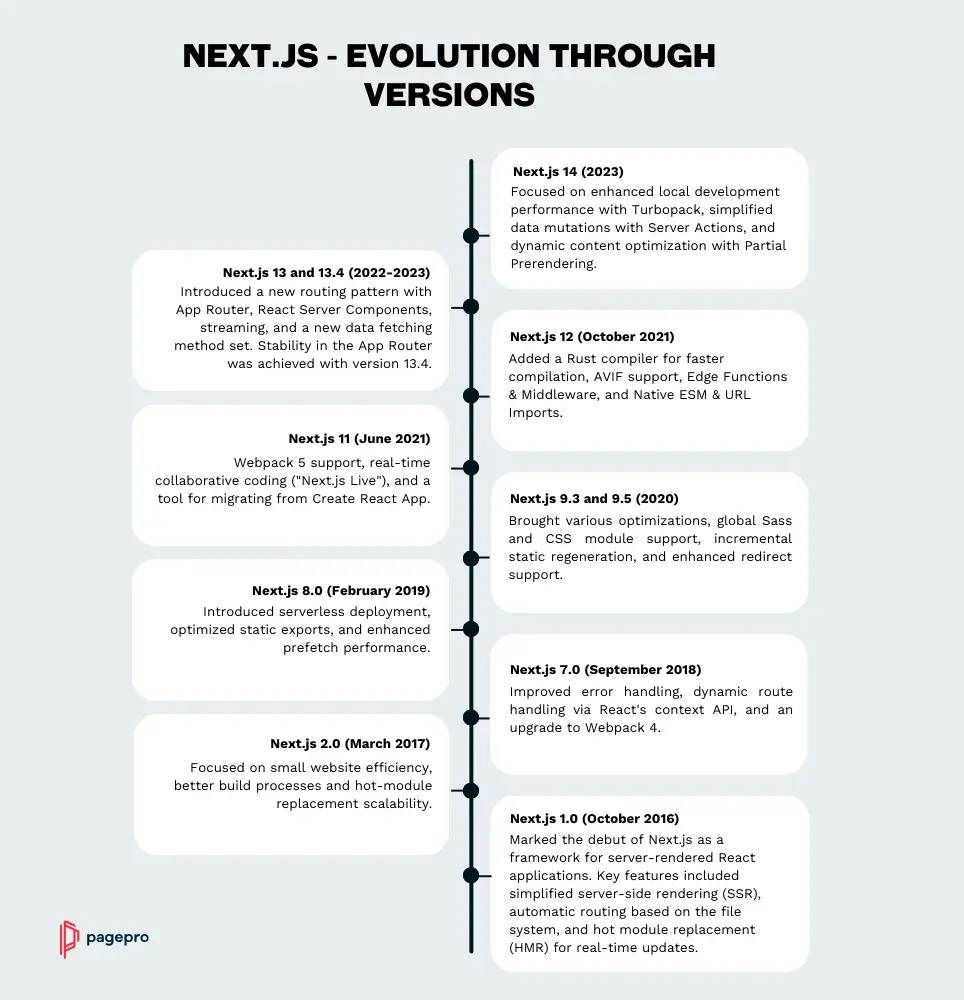
The History Of Next
Main Features
| Feature | Description |
|---|---|
Routing | A file-system based router built on top of Server Components that supports layouts, nested routing, loading states, error handling, and more. |
Rendering | Client-side and Server-side Rendering with Client and Server Components. Further optimized with Static and Dynamic Rendering on the server with Next.js. Streaming on Edge and Node.js runtimes. |
Data Fetching | Simplified data fetching with async/await in Server Components, and an extended fetch API for request memoization, data caching and revalidation. |
Styling | Support for your preferred styling methods, including CSS Modules, Tailwind CSS, and CSS-in-JS |
Optimizations | Image, Fonts, and Script Optimizations to improve your application's Core Web Vitals and User Experience. |
TypeScript | Improved support for TypeScript, with better type checking and more efficient compilation, as well as custom TypeScript Plugin and type checker. |